

Most entrepreneurs don’t build businesses, they build traps. They start with a skill, launch into doing the work, and before long, they’re drowning in tasks, chained to the very thing they thought would give them freedom.
Ask yourself: What’s the one part of my business I’m still clinging to because it feels safer to do it myself?
👥 Executive Insights | “Let me tell you how that played out in my company.“
- Your Name, Title, Organization + Insights
- Your Name, Title, Organization + Insights
- Your Name, Title, Organization + Insights
Working on the business means shifting from technician to architect, from doing the tasks to designing the machine that gets them done. When did stepping back from day-to-day operations lead to a breakthrough for your company? What specifically improved? What process or system did you finally document or delegate that made the biggest difference in freeing up your time?
⚠️ This Rule is currently under development and will be fully available on our official launch day, January 4, 2027. After launch, it will continue to evolve through real-world experience, member contributions, and timeless business principles—because great leaders never stop learning.
STUDY 📌 Rule No. 15 —Work on your business, not just in it.
📓 the LEDGER
the LEDGER is the recommended companion to your weekly study through The Weekly Edge. Each week includes a printable PDF designed to help you plan with intention, apply the Rule in real time, and record the decisions, priorities, and lessons that shape your leadership. You can print one week at a time and begin anytime throughout the year, or choose the full professionally printed spiral-bound hardcover LEDGER for a complete year of disciplined growth and reflection.
— the LEDGER Volume 1 will be available this Summer 2026 through this site
This rule helps you:
Escape the Operator Trap: Recognizing when you’ve become too entangled in daily operations and learning how to delegate, document, and design for scale.
Build Systems That Scale: Creating repeatable processes so the business can run smoothly without constant oversight or micromanagement.
Shift to Strategic Thinking: Prioritizing time for vision, planning, and high-leverage decisions instead of firefighting and busywork.
Preserve Sanity and Sustainability: Avoiding burnout by learning to build a business that supports your life—not consumes it.
 Write this down…
If the business can’t run without you, you don’t own a business—you own a job.
— The Trap That Catches Most Founders
The founder who is indispensable to daily operations has not built a business. They’ve built a job.
Michael Gerber’s observation from the 1980s remains one of the most accurate descriptions of small business failure ever written. The person who starts a company is often the most skilled at the core work — the baking, the coding, the consulting, the craft. And so they do the work. All of it.
“If you’re the whole company, you don’t own a business — you own a job.”
The business grows to the edge of what one person can handle, and then it stops. Because the founder never built the systems, the processes, or the team that would allow the business to function without them.
Working on the business — designing it, improving its systems, developing its people, building its future — requires time. That time has to be protected deliberately, because the demands of daily operation will consume it otherwise.
The most effective operators I’ve observed hold non-negotiable time for strategic work. They treat their role as business architect as seriously as they treat their role as practitioner.
Work on the business, not just in it is one of the clearest principles at The Executives Institute, and among the most universally violated. Most leaders know it’s true. Very few have actually built the habit.
The business you want to run in five years has to be designed today.

Here are 5 warning signs that signal you are ignoring this Rule:
⚠️ The Day Is Consumed by Firefighting – Strategy, planning, and vision take a back seat while the owner spends all day putting out operational fires.
⚠️ No Documented Processes – Work lives in people’s heads, not in systems. New hires struggle because there’s no playbook to follow.
⚠️ Growth Equals More Chaos – Instead of scaling smoothly, every new client or employee creates more stress and longer hours for the owner.
⚠️ Time Off Feels Impossible – The thought of taking a week away causes panic because the business would grind to a halt without them.
⚠️ The Owner Is the Bottleneck – Every decision, approval, or client issue runs through them. If they’re unavailable, progress stalls.

💬 Executive Discussion
Most owners have at least one part of the business they refuse to release—the task, the decision, or the role that feels too important, too delicate, or too tied to their identity to hand off. Among peers, there’s no hiding from that truth. This question cuts to the core of why so many founders stay trapped in the day-to-day. It forces us to confront the comfort zones that quietly limit our growth and keep the business dependent on us.
Discuss with fellow CEOs and Owners
🔍 What’s the one part of your business you’re still clinging to because it feels safer to do it yourself—and what’s the real cost of not letting it go?
Ask Yourself —
What parts of my business still rely solely on me—and what’s the cost?
🛠️ Rule No.15 Self-Assessment: Are You Working On or In Your Business?
For each statement, check the one that feels closest to your reality:
1. Daily Operations
- ☐ Everything stops if I’m not there.
- ☐ My team knows what to do and keeps moving without me.
2. Systems and Processes
- ☐ Most of the work lives in people’s heads, including mine.
- ☐ We have documented, repeatable systems anyone can follow.
3. Time and Focus
- ☐ My days are consumed by tasks and firefighting.
- ☐ I spend most of my time on strategy, growth, and relationships.
4. Problem-Solving
- ☐ Every issue eventually lands on my desk.
- ☐ Challenges get resolved at the right level by the right people.
5. Growth Impact
- ☐ More clients or employees = more chaos.
- ☐ Growth fits into existing systems and creates momentum.
Your Scorecard
A Mix of Both: You’re in transition—progress is happening, but there are still weak spots to address.
Mostly Top answers: You’ve built yourself a job, not a business. Time to step back and re-engineer.
Mostly Bottom answers: You’re working on the business. Keep refining and delegating.
Ask Yourself —
What’s the one improvement that would make it easier next month?

Real-Life Scenario: The Overworked Founder
Sarah launched a marketing agency five years ago. She was great at client work—writing copy, building campaigns, and managing accounts—so the business grew quickly. But instead of running a company, Sarah became the company. She was the first one in, the last one out, approving every client deliverable, fixing mistakes, hiring staff, chasing invoices, and even buying office supplies.
On paper, the business looked successful. In reality, Sarah was exhausted, constantly firefighting, and terrified to step away—even for a week—because she knew everything would fall apart without her.
The turning point came when she realized she wasn’t building a business at all—she was just working another job, except this time she was the boss, the employee, and the janitor all in one. By shifting her mindset to work on the business, she started building systems:
- Documented client onboarding so account managers could run it without her.
- A sales process that any trained rep could follow.
- Financial dashboards that gave her visibility without micromanaging.
Within a year, Sarah could finally take time off, her team operated with confidence, and the business kept growing—because it was no longer dependent on her doing everything.
If the only way your company works is because you’re there pushing every decision, every task, every fire—then you didn’t build a business, you built a dependency. The real move is designing systems so good that the company keeps improving even when you’re not in the room. Great operators work hard in the business. Great owners redesign the business so hard work isn’t required everywhere.
If you step back, systematize, and lead strategically, you can build something that runs without your constant presence. This isn’t about working less—it’s about working on what matters most. Successful businesses aren’t built by overworked operators—they’re built by owners who step back, see the big picture, and design systems that scale.
Action Step —
Block two hours this week for strategic planning, not daily operations.
Actionable Strategies 🔁
Here are 3 actionable strategies that drive this rule from theory into practice.
1. Systematize One Core Process Every Month
Pick one recurring task—client onboarding, sales follow-up, invoicing, whatever eats time—and document it step-by-step. Test it with someone other than you. If they can run it without questions, it’s a usable system. Do this monthly and, within a year, the business runs on process rather than personality.
2. Delegate the Highest-Value Task You Still Control
Not the easiest task—the highest-value one you refuse to hand off. Audit your week, identify the responsibility that’s keeping you in the weeds, and assign it to the most capable person on your team. Provide clarity, guardrails, and the authority they need to own it fully.
3. Block Weekly Strategy Time—and Protect It Ruthlessly
Reserve a 90-minute block each week dedicated to working on the business: reviewing systems, monitoring leading indicators, studying the pipeline, and planning ahead. No urgent tasks, no interruptions. If you treat this time casually, everything else will continue to own your schedule.
Here are 5 Green Flags that show you are living out Rule No.15 — Work On Your Business, Not Just In It:
✅ Growth Feels Manageable, Not Overwhelming
– New clients or employees fit into existing systems, creating momentum instead of chaos.
✅ The Business Runs Without You
– Operations continue smoothly even when you step away for a week—or a month.
✅ Systems Drive Consistency
– Processes are documented, repeatable, and followed. Success doesn’t depend on one person’s memory or mood.
✅ You Spend More Time on Strategy Than Tactics
– Your calendar reflects vision-setting, growth planning, and relationship building—not endless daily tasks.
✅ Problems Are Solved at the Right Level
– Your team handles operational challenges without everything escalating to your desk.
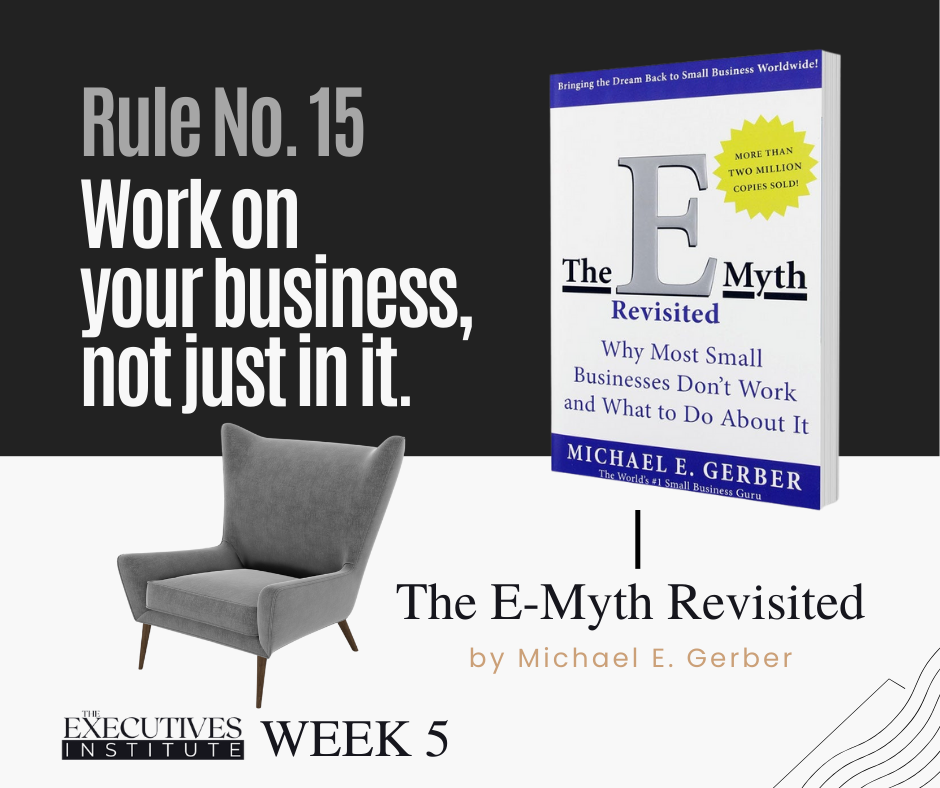
📚 Recommended Reading
The E-Myth Revisited
by Michael Gerber
“The problem is not that people fail to work hard enough. The problem is that they work hard at the wrong things.” — Michael Gerber
Key Executive Takeaway
The book argues that lasting success comes from building systems, processes, and structures that allow a business to run without relying on the owner’s constant presence. In short, a business should be designed like a franchise—even if you never intend to franchise it—so it’s scalable, consistent, and sustainable.
Don’t just work harder in your business. Work smarter on your business, so it can thrive without you.
📚Quick Summary
Michael E. Gerber’s The E-Myth Revisited dismantles the romantic idea of entrepreneurship—the belief that technical skill alone is enough to build a thriving business. Most small business owners don’t truly own businesses; they own jobs. They get trapped working in the business (as technicians), instead of working on it (as architects).
Gerber introduces the Three Roles every owner must balance:
- Technician: Doing the work.
- Manager: Creating order and efficiency.
- Entrepreneur: Driving vision and growth.
The book argues that lasting success comes from building systems, processes, and structures that allow a business to run without relying on the owner’s constant presence. In short, a business should be designed like a franchise—even if you never intend to franchise it—so it’s scalable, consistent, and sustainable.
More quotes from The E-Myth Revisited:
- “If your business depends on you, you don’t own a business—you have a job. And it’s the worst job in the world because you’re working for a lunatic.”
- “The purpose of going into business is to get free of a job so you can create jobs for other people.”
- “Great businesses are not built by extraordinary people, but by ordinary people doing extraordinary things.”
- “Your business is not your life. Your business and your life are two separate things.”
- “Businesses that fail are those that rely on extraordinary people. Businesses that succeed are those that build extraordinary systems.”
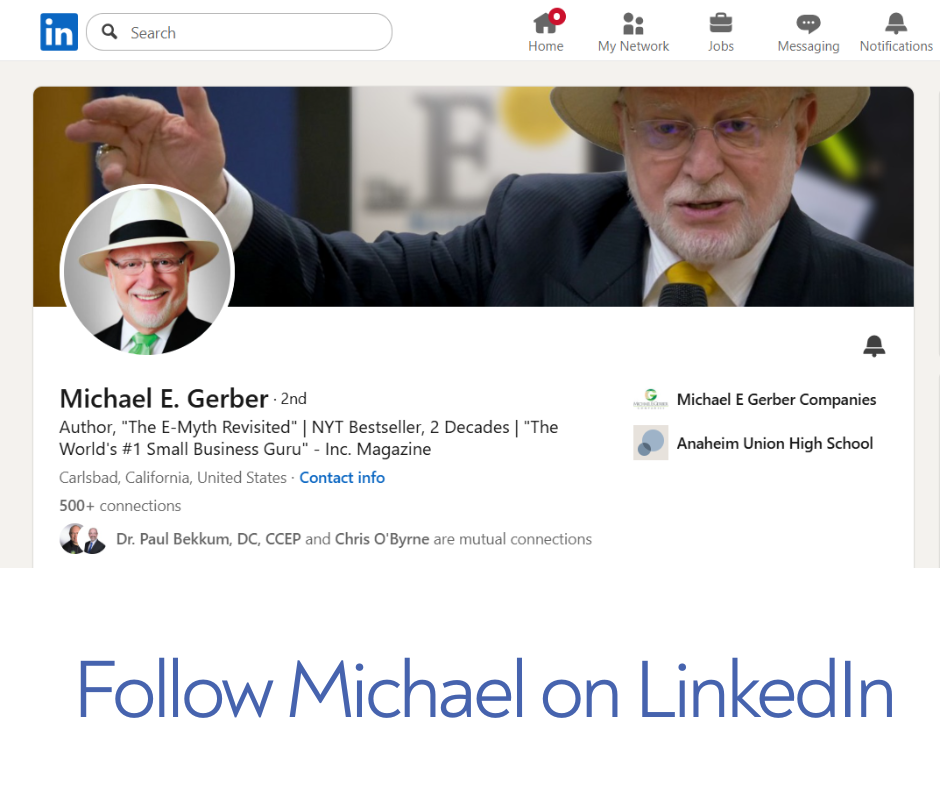
Michael E. Gerber, was named the World’s Number One Small Business Guru by Inc. Magazine, and received the Lifetime Achievement Award from National Academy of Bestselling Authors, 2010. He was our Marketing Summit key-note speaker and is the best selling author of “The E-Myth – Why Most Small Businesses Don’t Work and What to Do about it”. Watch his key-note presentation now and begin to work ON your business instead of working in your business.

Subscribe to The Executives Institute YouTube Channel

Each Rules to Results Workshop
is built for your leadership team to dissect one rule, debate the insights, and walk out with clarity—not just theory.
1 Rule,
1 conversation,
1 shift that moves your business forward.
Always under 60 minutes.
Rules to Results Workshop: Rule No.15
Work On Your Business, Not Just In It
Duration: 60 minutes
Audience: Leadership Team
1. Opening Statement (2 minutes)
Set the tone:
“Today we’re drawing a sharp line between doing the work and building the machine that does the work. This session is about exposing the choke points, documenting what matters, and freeing leadership to actually lead.”
2. Rule Breakdown (5 minutes)
A fast refresher so everyone is grounded:
- Working in the business = tasks, firefighting, and role confusion.
- Working on the business = systems, strategy, delegation, and clarity.
- Growth depends on shifting from technician-mode to builder-mode.
3. Red Flags Scan (8 minutes)
Have each leader identify where they see this rule being ignored.
Prompt:
“Circle the red flags happening in your area of the business. What’s still too dependent on one person—especially the owner?”
Quick share-out: What themes do you see repeating?
4. Small-Group Dissection (10 minutes)
Break into groups of 2–3.
Each group answers:
- Where are we over-reliant on individuals instead of systems?
- What undocumented process is costing us the most?
- What would break if our key people vanished for 30 days?
Each group reports one hard truth back to the room.
5. Systems Priority Map (10 minutes)
As a full team, identify the top three areas that must be systematized or delegated.
Criteria:
- High frequency
- High impact
- High risk if mishandled
- Currently dependent on one person
Put these three on the board. These become the team’s “System Build Priorities.”
6. The Owner Trap Discussion (10 minutes)
As a team (no judgment, just honesty):
“What is the owner still holding onto that the business needs to grow past?”
Define one owner responsibility that must shift this quarter—and identify who or what will take it.
7. The One-Page Action Plan (12 minutes)
Close with clarity, not theory. For each of the 3 System Build Priorities, define:
- Owner: Who is responsible for building the system?
- Timeline: What’s the deadline for the first draft?
- Dependencies: Training, documentation, tools, etc.
- Success Test: How will we know the system works without the owner?
End with commitments and deadlines.
Closing Line (1 minute)
“If the business can’t run without you, it doesn’t truly belong to you. Let’s fix that—starting now.”
 This Rule isn’t finished—and it never will be. Business changes, leaders learn, and our Members keep sharpening the edges with real stories and hard-won lessons. What you see here is today’s version. Tomorrow’s will be better, clearer, and backed by more lived experience.
Thank you for being here and bringing your perspective—add your insight, share a story, or challenge what’s written. Together, we keep these Rules alive and relevant.
Congratulations—you’ve laid the groundwork!
By studying these first five Rules, you’ve done more than just begin—you’ve made a commitment to build something that lasts. Foundations aren’t flashy, but they are everything. The strongest companies, teams, and leaders return to these principles often, especially when the path gets unclear.
When you’re ready, the next chapter is waiting.
In it, we shift from groundwork to momentum—taking what you’ve built and turning it into traction. We’ll cover the Rules that drive action, consistency, and early growth—the habits that separate those who stall from those who scale.