
🎓 MASTER Rule No. 2 —Fall in love with the problem, not the solution.
Solutions come and go, but a deep understanding of the real problem creates lasting value. Focus on the true needs and challenges of your customers (not your preconceived ideas). By anchoring yourself to the problem, you remain flexible, innovative, and better positioned to deliver meaningful solutions. This keeps you customer-centered, not ego-driven.
👥 Executive Insights | “Let me tell you how this Rule played out in my company.“
- Your Name, Title, Organization + Insights
- Your Name, Title, Organization + Insights
- Your Name, Title, Organization + Insights
Think of a turning point in your company where reframing the problem changed everything.
🛠️ 08.15.2026 | We are building each Master the Rule lesson and each will be ready for our first official day of LinkedIn discussions, Monday, January 4, 2027.
Connect With Our Founder on LinkedIn
Each of the 50 Rules of Business will contain the study sections listed below and will continue to evolve through your insights and contributions. As business leaders continue to challenge these ideas, the Institute becomes more and more valuable, not because it’s finished, but because it never will be.
- When to Apply | Red Flags
- Rule Overview
- Ask the Right Questions
- Contrarian View
- Actionable Strategies
- Real World Scenarios
- Leadership Team Discussion
- Rules to Results Workshop
- The Right Track | Green Flags
- Key Terms
- Book Summary
- Author Links
- Executive Insights
- Worth Watching
- Related Reading

Look for these red flags 🚩 that your business, your team, or you might be drifting away from this principle.
You may have lost sight of the real problem if…
🚩 You haven’t talked to a real customer in weeks, or ever. —It’s easy to get isolated. Get out of the office.
🚩 You hear “we just need better marketing” —If your not gaining traction, your instinct is to blame brand awareness, but you might be selling something the market doesn’t want.
🚩 Customers aren’t complaining, but they’re not engaging either. —Apathy is often louder than complaints. If users are quiet, your solution may be irrelevant.
🚩 Internal conversations revolve around the product, not the customer. —When team meetings focus more on features than the end user’s actual struggles, it’s time to re-center around the problem.
🚩 You’re filtering feedback to fit your original idea. —If you’re dismissing negative feedback or interpreting vague interest as validation, confirmation bias is likely in play.
in progress…
📓 the LEDGER
the LEDGER is the recommended companion to your weekly study through The Weekly Edge. Each week includes a printable PDF designed to help you plan with intention, apply the Rule in real time, and record the decisions, priorities, and lessons that shape your leadership. You can print one week at a time and begin anytime throughout the year, or choose the full professionally printed spiral-bound hardcover LEDGER for a complete year of disciplined growth and reflection.
— the LEDGER Volume 1 will be available this Summer 2026 through this site
Practicing this Rule will help you:
- Avoid emotional attachment to “pet projects” that lack market fit
- Build products and services that customers actually want
- Pivot more effectively when initial ideas fall flat
- Stay adaptable in fast-changing markets
- Make smarter decisions backed by real customer insight
 Write this down…
Solutions change. The problem worth solving rarely does.
Now that you’ve identified your customer’s real problem, let me challenge you with a question that requires and little ego check. Ask yourself…
Are we defending our solution…or are we actually solving our customer’s real need?
— The Trap Smart Founders Fall Into
The smarter the founder, the more dangerous the trap.
Intelligent people are excellent at building compelling arguments. They can rationalize a product direction with logic that sounds airtight. They can explain why the market needs what they’ve built. They can find evidence to support almost any conclusion they’ve already reached.
This is exactly the problem.
I’ve been there. You invest capital. You commit payroll. You rally your team. And once you do, it’s human nature to protect what you’ve built. But protecting your idea and solving the right problem aren’t the same thing. If you find yourself explaining to your team why customers should care, instead of proving that they already do, that’s a warning sign.
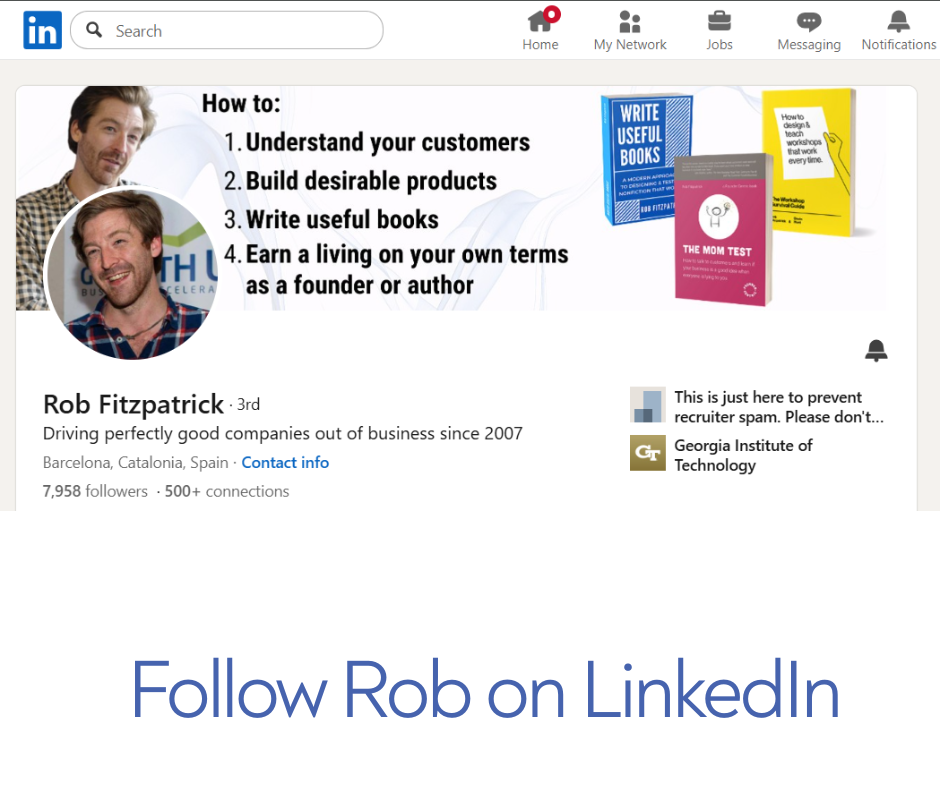
In his book, The Mom Test, Rob Fitzpatrick wrote clearly about what happens when entrepreneurs ask the wrong questions. They talk to potential customers and hear what they want to hear. The customer is polite. The founder is encouraged. And the product gets built on a foundation of misread signals.
“Your idea is amazing. Your customer just doesn’t care.”
The discipline is to stay attached to the problem, not the solution you’ve already invented. That means asking customers about their lives, their frustrations, their workarounds — not about whether they’d buy what you’re about to pitch them.
One of our core principles at The Executives Institute reflects this directly: Fall in love with the problem, not the solution. It is deceptively simple advice. It is also among the hardest to actually practice.
The solution will change. The problem, if it’s real, won’t.

💬 Leadership Team Discussion
Before we commit resources, rally the team, or launch a new idea, we should pause and ask: are we solving a real, painful problem—or just building something we’re excited about?
Falling in love with our own solution can blind us to what customers actually need. This discussion is about stepping back, getting honest, and making sure we’re anchored to the problem—not the product.
Think of a major product or strategy currently in motion in your organization.
Discuss with your leadership team:
How do we know this is a real and urgent problem worth solving?
What evidence do we have?
Encourages evidence over assumption. Push for real data, customer conversations, and behavioral signals—not just gut instinct or internal excitement.
🔍 Additional Executive Questions about discovering real customer needs
1. What evidence would force us to abandon or rethink our current solution?
If there’s no clear answer, you’re not actually open to discovering the truth.
2. When was the last time you personally observed a customer struggling with the problem you claim to solve?
If the answer is vague or second-hand, discovery has likely been delegated too far away from decision-makers.
3. What do customers consistently complain about—even when it has nothing to do with your product?
Real needs often surface in frustration, not feature requests.
4. What customer behavior surprised you in the last 90 days?
If nothing comes to mind, you may be relying on assumptions instead of observation.
5. Which customer insight caused you to change course—not just refine execution?
If insights never lead to meaningful change, they’re probably not real insights.
6. What problem do customers solve without you today?
This reveals both competition and the true priority of the problem.
7. Whose job is it to challenge whether we’re solving the right problem—and how often do they do it?
If no one owns this role, solution attachment is likely running the show.

Contrarian View (for healthy debate)
“At what point does staying ‘in love with the problem’ become an excuse for avoiding commitment to a solution—and costing the business time, momentum, and results?”

Here’s a scenario…
A SaaS founder spent months building a sleek scheduling app. Investors liked the interface, and early testers praised the features. But user adoption was flat. When the team finally sat down with potential customers—without pitching—they uncovered a deeper issue: their target users didn’t struggle with scheduling, but with coordinating follow-up. The real pain wasn’t the calendar; it was the workflow after the meeting.
The company pivoted, building lightweight automation for post-meeting tasks. Adoption took off—because now, they were solving the real problem.
THE LESSON: The market doesn’t care how clever your solution is.
It cares whether you’ve solved something painful.
Listen more. Build less. Validate always.
Rule No. 2 —Fall in love with the problem, not the solution.

WEEK 2 | Action Step —
Commit to having two customer or prospect conversations. Don’t pitch—just ask questions. Then, list three ways your current solution could fail, and rethink from the problem backward.
🔁 Actionable Strategies
🗂 Implement “Problem Reviews” instead of just Product Reviews
In your leadership meetings or sprint kickoffs, dedicate time to reviewing what problem you’re solving, for whom, and how you know it still matters. Track this the same way you would KPIs.
🗂 Ban solution-first thinking in early-stage brainstorming
For the first half of ideation sessions, only allow team members to bring up customer problems, not solutions. It forces deeper empathy and widens your field of view.
🗂 Set a “3 Alternatives” Challenge
Anytime a new solution is proposed, require the team to list three other ways to solve the same problem. This exposes assumptions and encourages creative, problem-first thinking.
🗂 Create a Problem Validation Scorecard
Before investing in a new initiative, score it across criteria such as problem urgency, frequency, financial impact, and customer behavior. Don’t move forward without a high score.
🗂 Assign a “Problem Owner” for each product or initiative
While product managers focus on delivery, the Problem Owner ensures the team remains grounded in the actual user challenge. They are responsible for continuous validation and redefinition.
🗂 Regularly revisit and reframe the problem statement
Every 30–60 days, require teams to restate the core problem they’re solving in one sentence. If it’s changed—or unclear—that’s your cue to pause or pivot.
🗂 Use job-shadowing or direct observation, not just surveys
Encourage your teams to sit with customers, observe workflows, or join customer support calls. Real problems often reveal themselves in behavior, not answers.
🗂 Reward internal red-flag raising
Create psychological safety by praising team members who question whether a solution is still solving the right problem. It builds a culture of intellectual honesty.
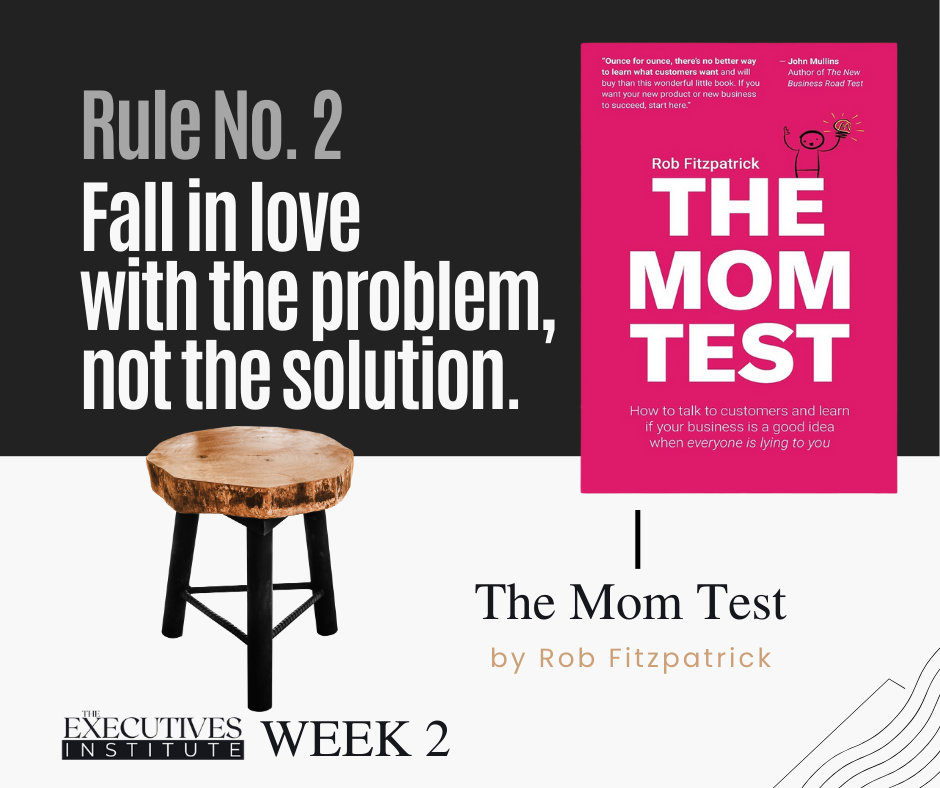
WEEK 2 | Recommended Reading —
The Mom Test by Rob Fitzpatrick
“You’re not allowed to tell them what their problem is. They have to tell you.” — Rob Fitzpatrick
📘 Book Summary
The Mom Test by Rob Fitzpatrick is a short, tactical guide to asking better questions and getting honest, useful feedback when talking to customers. The central premise is simple: you can’t trust people—especially your mom—to tell you the truth if your questions are flawed.
Fitzpatrick teaches entrepreneurs how to avoid biased feedback by asking about past behaviors rather than opinions or hypotheticals. Instead of asking, “Would you use this?”, you learn to ask, “How have you solved this in the past?” The goal is to uncover real pain points, not polite compliments.
This book is a must-read for anyone building products, launching a business, or trying to truly understand their audience. It emphasizes listening over pitching and relentlessly testing assumptions.
Key Executive Takeaway
Never trust compliments, guesses, or hypotheticals in customer conversations. Instead, focus relentlessly on uncovering real problems, real priorities, and real behavior. Great businesses aren’t built by pitching ideas and hoping for validation—they’re built by listening, testing, and solving problems that matter.

Subscribe to The Executives Institute YouTube Channel
Key Terms for Rule no.2
Problem-Market Fit
The degree to which a real, pressing problem exists in the market—and how well it’s understood. Achieving this comes before product-market fit and determines whether a solution is even worth building.
Confirmation Bias
The tendency to seek, interpret, or remember information in a way that confirms preexisting beliefs—often causing teams to hear what they want to hear from customers, rather than what’s actually being said.
Customer Discovery
A process of interviewing and observing potential users to deeply understand their problems, behaviors, and needs—without pitching a solution.
Solution Attachment
An emotional or cognitive bias toward a specific idea or product, making it hard to pivot even when the evidence suggests it’s not working.
The Mom Test
A concept and shorthand for asking better, unbiased customer questions—ones that don’t invite compliments, vague affirmations, or false positives. Named after the idea that “even your mom will lie to you if you ask the wrong way.”

Each Rules to Results Workshop
is built for your leadership team to dissect one rule, debate the insights, and walk out with clarity—not just theory.
Fall in Love With The Problem Workshop
⏱️Duration: 45 minutes
Objective: Help business leaders re-center teams, initiatives, and strategies around the real customer problem—before committing to a solution that may miss the mark.
🛠️Workshop Agenda
5 min. | Welcome & Framing the Rule
- Briefly introduce Rule No. 2 and why it matters across all business stages.
- Emphasize: Solutions change. Problems endure. Fall in love with the right one.
10 min. | Discussion Prompt + Executive Reflection
“Think of one major initiative, product, or strategy currently in motion.”
Ask participants to individually reflect and write:
- What problem is this solving—and for whom?
- What evidence do we have that this is a real, urgent problem?
- If this solution didn’t exist, what other ways could we attack the same issue?
Facilitator Tip: Encourage brutal honesty and remind them: vagueness is a red flag.
10 min. | Group Share & Pattern Spotting
- In pairs or small groups, share insights from the reflection.
- Prompt: “Where are we clearly problem-focused? Where are we solution-attached?”
- Identify themes or blind spots. Capture a few examples on a whiteboard or shared doc.
10 min. | Action Strategy: The Problem Validation Scorecard
Introduce a simplified Problem Validation Scorecard:
- Score your idea/initiative 1–5 on:
- Urgency of the problem
- Frequency the customer experiences it
- Financial or emotional cost of the problem
- Customer willingness to change or pay
- Discuss results. Does the initiative earn the right to move forward?
5 min. | Real-Life Insight + Group Takeaways
- Think of a relevant local business example focused on the solution.
- Prompt: “What did they do right? What did they do early enough?”
- Ask: “What would this mindset shift change in your own business today?”
5 min. | Wrap-Up & Commitment
Ask each leader to write down one conversation they’ll have this week to validate a problem before investing more in a solution.
Revisit the quote: “You’re not allowed to tell them what their problem is. They have to tell you.” — Rob Fitzpatrick
Congratulations —you’re already doing what most leaders avoid—stepping back to challenge your assumptions. That’s the real work. Falling in love with the problem, not your solution, requires humility, curiosity, and discipline. It’s not easy—but it’s what separates reactive businesses from resilient ones.
The best leaders never stop listening. They ask better questions. They walk away from pet ideas. And they keep their teams grounded in what actually matters to the people they serve.
By engaging with this Rule, you’re not just building smarter solutions. You’re building a better business.
Note from The Executives’ Institute:
You may notice that some of our Business Rules overlap, echo similar themes, or even repeat certain language, such as Rule No. 1 and Rule No. 2. That’s not a mistake—it’s intentional. Great businesses aren’t built on one-time insights, but on fundamental principles reinforced again and again in different contexts.
At The Institute, we believe repetition is a feature, not a flaw. It’s how important ideas take root. When multiple rules point toward the same truth from different angles, it means you’re onto something worth paying attention to.
 This Rule isn’t finished—and it never will be. Business changes, leaders learn, and our Members keep sharpening the edges with real stories and hard-won lessons. What you see here is today’s version. Tomorrow’s will be better, clearer, and backed by even more field-tested experience.